MT700 Fields Explained: Every Letter of Credit Clause, 27 to 78
A letter of credit may arrive as a SWIFT MT700, and the clauses people search for (44C, 31D, 46A) are its numbered fields. This reference explains each field in order, the documents or bank instructions it relates to, and what to check before presentation.
Audience: export documentation teams, trade finance staff, freight forwarders and customs brokers who prepare presentations under a letter of credit
When a bank issues a documentary credit through SWIFT, it sends the advising bank a SWIFT message of type MT700. The credit's terms are set out in that message and any continuation messages or amendments, in fields identified by a tag such as 31D or 44C. Bankers, forwarders and exporters call them "clauses", and when a presentation comes back with a discrepancy the refusal notice must identify each discrepancy, though it need not quote an MT700 tag.
This page walks through the fields in the order they appear in the message. For each one, it explains what the field means, which of your documents has to agree with it, and what typically goes wrong. The rules behind the checks are the ICC's UCP 600 and ISBP 821 (2023 edition). The relevant article is named where it matters; express credit terms can modify the defaults. If you want the view from the other side, the one that groups the same fields by what the bank is checking for, read which clauses you need to validate for a letter of credit.
A note on the tags: a lowercase letter, as in 41a or 42a, means the field comes in more than one format. 41A identifies the bank by its BIC, 41D by name and address. The purpose is the same, so this reference treats them as one field.
See the annotated example for a fictional credit with the key clauses highlighted.
The fields at a glance
| Tag | Field | What to check |
|---|---|---|
| 27 | Sequence of total | The MT701 continuation messages |
| 40A | Form of documentary credit | Transfer requests, standby wording |
| 20 | Documentary credit number | Every document that quotes the L/C number |
| 23 | Reference to pre-advice | The earlier MT705, if one was sent |
| 31C | Date of issue | Document dates; earlier dates are generally allowed |
| 40E | Applicable rules | The examination standard applied to everything else |
| 31D | Date and place of expiry | The date and place of your presentation |
| 51a | Applicant bank | Nothing you present |
| 50 | Applicant | Invoice addressee, notify party, consignee where stated |
| 59 | Beneficiary | Invoice issuer and drawer of any required draft |
| 32B | Currency code, amount | Invoice total and draft amount |
| 39A | Percentage credit amount tolerance | Amount drawn; check quantity tolerance separately |
| 39C | Additional amounts covered | Additional amounts and the evidence needed to claim them |
| 41a | Available with, by | The bank for presentation and the payment method |
| 42C | Drafts at | The tenor written on the draft |
| 42a | Drawee | The bank the draft is drawn on |
| 42M | Mixed payment details | Payment amounts, due dates and any draft requirements |
| 42P | Negotiation or deferred payment details | Maturity calculation on the covering letter |
| 43P | Partial shipments | Means of conveyance, journey and destination |
| 43T | Transhipment | Routing shown on the bill of lading |
| 44A | Place of taking in charge, dispatch, receipt | Place of receipt on a multimodal document |
| 44E | Port of loading, airport of departure | Port of loading and on-board notation on the B/L |
| 44F | Port of discharge, airport of destination | Port of discharge on the B/L |
| 44B | Place of final destination, delivery | Place of delivery on a multimodal document |
| 44C | Latest date of shipment | Shipment date under the relevant transport rule |
| 44D | Shipment period | Shipment dates, read with UCP 600 article 3 |
| 45A | Description of goods and services | Invoice description must correspond with the credit |
| 46A | Documents required | The documents in the presentation, their issuers and copies |
| 47A | Additional conditions | Whatever document each condition names |
| 49G | Special payment conditions for beneficiary | Your expectation of when and how you're paid |
| 49H | Special payment conditions for receiving bank | Bank-to-bank only |
| 71D | Charges | What's deducted from your proceeds |
| 48 | Period for presentation in days | Days between shipment date and your presentation |
| 49 | Confirmation instructions | Whether confirmation is requested or authorised |
| 58a | Requested confirmation party | Bank-to-bank only |
| 53a | Reimbursing bank | Bank-to-bank only |
| 78 | Instructions to the paying, accepting or negotiating bank | How documents are forwarded and how you're reimbursed |
| 57a | Advise-through bank | Any second bank through which the credit is advised |
| 72Z | Sender to receiver information | Bank-to-bank only |
A sample MT700 with highlighted clauses
This sample bank document covers a fictional credit for 1,000 valves shipped from Shanghai to Jebel Ali for USD 50,000. The highlighted clauses link to their explanations below.
Sample letter of credit
Select a yellow highlight to read about that clause.
Scroll sideways to read the full page, or open the PDF to zoom in.
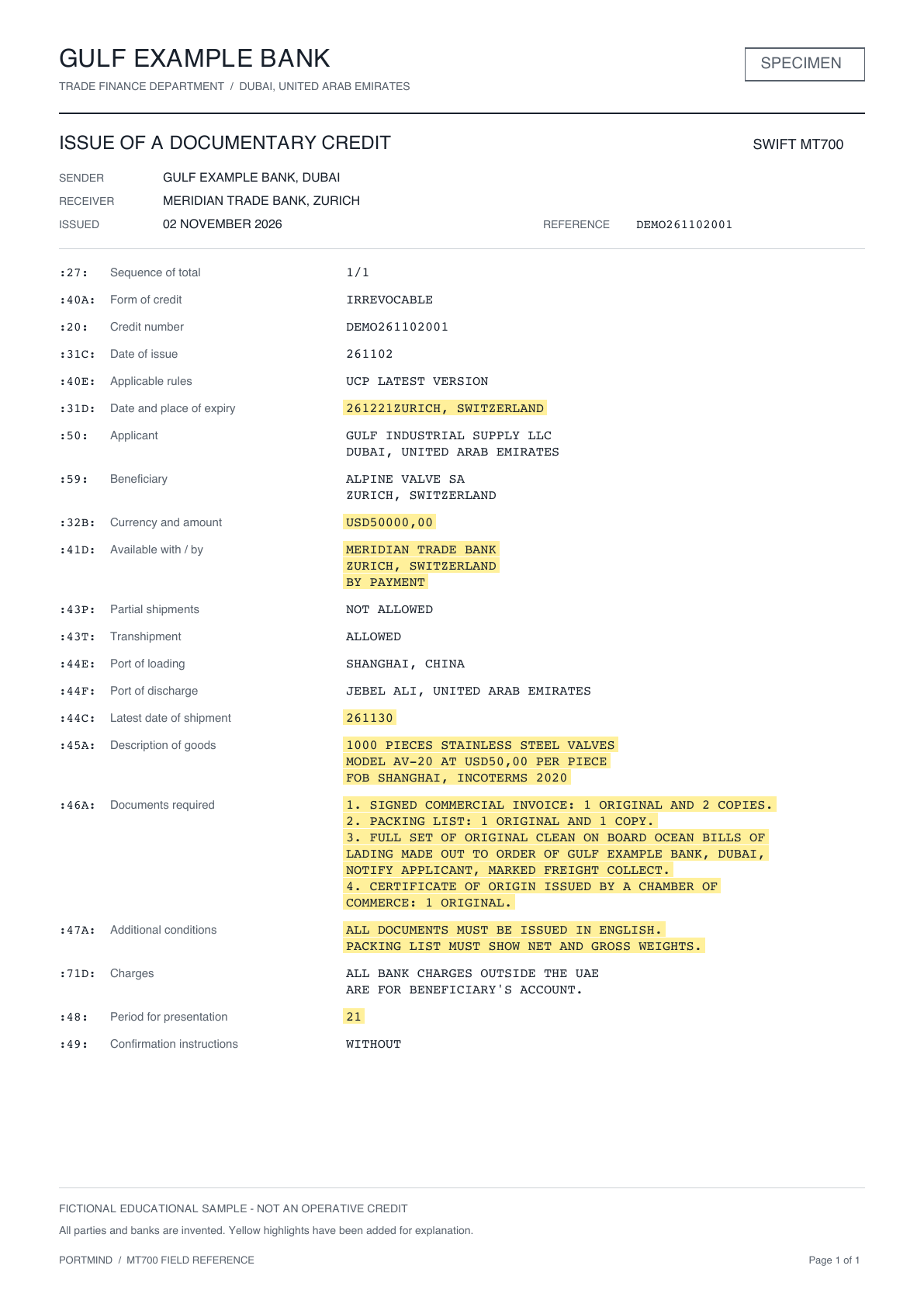
Fictional educational sample. All parties and banks are invented.
Notice how fields 31D and 48 work together: for shipment on 27 November, the 21-day presentation period ends on 18 December, even though the credit expires on 21 December.
Read the document as text
- :27: Sequence of total
- 1/1
- :40A: Form of credit
- IRREVOCABLE
- :20: Credit number
- DEMO261102001
- :31C: Date of issue
- 261102
- :40E: Applicable rules
- UCP LATEST VERSION
- :31D: Date and place of expiry
- 261221ZURICH, SWITZERLAND
- :50: Applicant
- GULF INDUSTRIAL SUPPLY LLC DUBAI, UNITED ARAB EMIRATES
- :59: Beneficiary
- ALPINE VALVE SA ZURICH, SWITZERLAND
- :32B: Currency and amount
- USD50000,00
- :41D: Available with / by
- MERIDIAN TRADE BANK ZURICH, SWITZERLAND BY PAYMENT
- :43P: Partial shipments
- NOT ALLOWED
- :43T: Transhipment
- ALLOWED
- :44E: Port of loading
- SHANGHAI, CHINA
- :44F: Port of discharge
- JEBEL ALI, UNITED ARAB EMIRATES
- :45A: Description of goods
- 1000 PIECES STAINLESS STEEL VALVES MODEL AV-20 AT USD50,00 PER PIECE FOB SHANGHAI, INCOTERMS 2020
- :46A: Documents required
- 1. SIGNED COMMERCIAL INVOICE: 1 ORIGINAL AND 2 COPIES. 2. PACKING LIST: 1 ORIGINAL AND 1 COPY. 3. FULL SET OF ORIGINAL CLEAN ON BOARD OCEAN BILLS OF LADING MADE OUT TO ORDER OF GULF EXAMPLE BANK, DUBAI, NOTIFY APPLICANT, MARKED FREIGHT COLLECT. 4. CERTIFICATE OF ORIGIN ISSUED BY A CHAMBER OF COMMERCE: 1 ORIGINAL.
- :47A: Additional conditions
- ALL DOCUMENTS MUST BE ISSUED IN ENGLISH. PACKING LIST MUST SHOW NET AND GROSS WEIGHTS.
- :71D: Charges
- ALL BANK CHARGES OUTSIDE THE UAE ARE FOR BENEFICIARY'S ACCOUNT.
- :49: Confirmation instructions
- WITHOUT
Identity, dates and rules of the credit
27: Sequence of total
Tells you how many messages make up the credit, written as 1/1 or 1/3. A long credit spills into MT701 continuation messages, usually because 45A, 46A or 47A ran past the field length. If the sequence says 1/2 and you only have one message, you don't have the whole credit yet, and the missing half is where the conditions tend to be.
40A: Form of documentary credit
States whether the credit is IRREVOCABLE, IRREVOCABLE TRANSFERABLE, IRREVOCABLE STANDBY or IRREVOC TRANS STANDBY. Under UCP 600 article 3 a credit is irrevocable even when it doesn't say so, so the word that matters here is TRANSFERABLE. Without it, a request to transfer part of the credit to your supplier will be declined, whatever the applicant agreed with you by email.
20: Documentary credit number
The issuing bank's reference for the credit. Use it to identify the transaction and follow any credit instructions about quoting it. However, a missing or mistyped credit number on a document is not, by itself, a valid reason for refusal under ISBP 821. ICC guidance on ISBP 821.
23: Reference to pre-advice
Present only when the issuing bank sent a short pre-advice (an MT705) before the full credit, in which case this field quotes that reference. It tells you the credit you now hold supersedes the pre-advice. Nothing in your presentation has to match it.
31C: Date of issue
The date the credit was issued. Documents dated before the date of issue are acceptable under article 14(i), so a quality certificate issued the week before the credit arrived doesn't fail on that alone. What does fail is a transport document showing shipment before the credit's date of issue when 47A says "shipment after date of L/C", which is a common condition on credits issued late.
40E: Applicable rules
Names the rulebook: UCP LATEST VERSION is the normal entry, EUCP LATEST VERSION for electronic presentations, ISP LATEST VERSION for standbys under ISP98. Everything on this page assumes UCP 600, which is the current version. If the field says OTHR, check its accompanying narrative and any relevant terms elsewhere in the credit before relying on a UCP default such as the 21-day presentation period.
31D: Date and place of expiry
The last day on which documents can be presented, and the place where presentation has to be made, usually the country or city of the advising or nominated bank. Article 6(d) requires both. Two points often cause confusion. First, the expiry applies to presentation, not to shipment, so a presentation that arrives at the nominated bank the day after expiry is late even if the goods shipped a month earlier. Second, article 29 extends an expiry that falls on a day the bank is closed to the next banking day, but only for closures other than force majeure, and the nominated bank must state on its covering schedule that presentation was made within the extended time. The latest shipment date is not extended.
Read 31D with 41a. Delivery to a nominated bank within the applicable deadline is presentation; merely handing documents to a bank acting as a courier is not. If you present directly to the issuing bank, allow for transit time so the documents arrive before the deadlines. ICC guidance on direct presentation.
Parties
51a: Applicant bank
The applicant's own bank when it isn't the issuing bank. It appears in a minority of credits and nothing you present refers to it.
50: Applicant
The buyer, as the issuing bank has it on file. Under article 18(a)(ii) the commercial invoice must be made out in the name of the applicant. Article 14(j) allows address details to differ within the same country and generally disregards contact details. Copying the applicant block from field 50 is a useful preparation habit, but exact character matching is not the general examination standard.
The exception is the applicant's address and contact details used as consignee or notify-party details on a transport document: these must be as stated in the credit (article 14(j)). ICC guidance on strict compliance.
59: Beneficiary
You, as the issuing bank has you on file. The invoice must appear to have been issued by the beneficiary (article 18(a)(i), subject to the transferred-credit exception). The shipper need not be the beneficiary (article 14(k)). Standard abbreviations such as "Ltd" for "Limited" are not automatically discrepancies. Resolve a genuinely different legal identity before shipment rather than treating every spelling or address variation as a reason to amend the credit.
Amount
32B: Currency code, amount
The currency and the maximum amount available. The invoice total and the draft can't exceed it unless a tolerance applies through 39A or the words "about" or "approximately" (article 30(a), which allows 10% either way). Article 18(b) lets a nominated bank accept an invoice for more than the credit amount as long as it hasn't honoured or negotiated beyond the credit amount, but you should treat that as the bank's discretion rather than a right.
The currency code is checked too. A credit in EUR with an invoice in USD is a discrepancy even if the amounts convert.
39A: Percentage credit amount tolerance
Written as two numbers, for example 05/05, meaning the amount drawn may be up to 5% more or 5% less than 32B. This is an amount tolerance; do not automatically apply it to quantity. Article 30(b) separately permits a 5% quantity tolerance in certain cases, excluding quantities stated in packing units or individual items and provided drawings do not exceed the credit amount. Article 30(c) can permit an underdrawing of up to 5% even when partial shipments are prohibited, subject to its conditions. Read the amount, quantity, unit price and any express tolerance together.
39C: Additional amounts covered
Amounts the credit covers in addition to the goods, such as freight, insurance premium or interest, and the basis on which they're payable. Check how the credit requires these amounts to be claimed and evidenced. Their inclusion here does not, by itself, require a separate invoice line or set the insurance coverage required by 46A.
Availability and payment
41a: Available with, by
Names the bank you can present to (a specific bank, or ANY BANK for a freely negotiable credit) and the method: BY PAYMENT, BY ACCEPTANCE, BY NEGOTIATION, BY DEF PAYMENT or BY MIXED PYMT. Article 6(a) requires the credit to identify availability. Read this field with the place of expiry in 31D; a credit available with a nominated bank is also available with the issuing bank. A credit available with a named bank in another country, when 31D places expiry in your own country, is one to clarify before shipment if the place for presentation is unclear.
42C: Drafts at
The tenor of the bill of exchange, such as SIGHT or 90 DAYS AFTER BILL OF LADING DATE. Whatever appears here has to be reproduced on the draft, and the maturity has to be calculable from the documents presented. "90 days after sight" is fine; "90 days after invoice date" works only if the invoice carries a date the bank can rely on. Drafts drawn at the wrong tenor are among the most common discrepancies because the draft is often typed from a template rather than from the credit.
42a: Drawee
The bank the draft is drawn on, normally the issuing bank or the nominated bank. Article 6(c) says a credit must not be available by a draft drawn on the applicant, so if 42a names your buyer the credit is defective and should be amended. Drawing the draft on the wrong bank is a discrepancy even when every other field matches.
42M: Mixed payment details
Used when 41a says BY MIXED PYMT, and describes how the amount is split, for example 30% at sight and 70% at 60 days. Check the amount and due date of each part; separate drafts are needed only if the credit requires them.
42P: Negotiation or deferred payment details
Used when the credit is available by negotiation or deferred payment without drafts, and states when payment falls due, such as 60 DAYS AFTER SHIPMENT DATE. For that example, the bank calculates maturity from the actual shipment date on the transport document, not the latest permitted date in 44C. Other credits may use a different starting event.
Shipment terms
43P: Partial shipments
ALLOWED, NOT ALLOWED or CONDITIONAL. Article 31(a) allows partial drawings and shipments unless the credit says otherwise, so a blank or ALLOWED entry gives you flexibility and NOT ALLOWED removes it. Article 31(b) is the subtlety: a presentation with more than one bill of lading is not a partial shipment if the documents show shipment on the same vessel for the same voyage to the same port of discharge, even if the dates or ports of loading differ. Two containers on two vessels are a partial shipment; two containers on one vessel under two bills of lading are not.
43T: Transhipment
ALLOWED, NOT ALLOWED or CONDITIONAL. For a bill of lading, article 20(c) accepts a document that shows transhipment will or may take place as long as the whole carriage is covered by that one bill of lading, and even where the credit prohibits transhipment, a bill of lading showing it is acceptable if the goods are in containers, trailers or LASH barges as evidenced by the bill of lading. The result is that NOT ALLOWED has less effect on containerised cargo than shippers expect, while article 23(c) also allows transhipment under a single air transport document despite a prohibition.
44A: Place of taking in charge, dispatch from, place of receipt
The place where the carrier takes the goods over, used with multimodal transport documents. The place of receipt on the document has to match it. Read it with 46A and the stated transport route: a place-of-receipt entry alone does not determine which transport document is required.
44E: Port of loading, airport of departure
The port the credit requires shipment from. Under article 20(a)(iii) the bill of lading must show shipment from the port of loading stated in the credit, with the on-board notation requirements depending on the document wording, any pre-carriage and any "intended" vessel or port entries. "Any port in China" is acceptable if the credit says so; "Shanghai" when the bill of lading shows Ningbo is not. Where the credit lists a geographical area, the bill of lading must still show the actual port.
44F: Port of discharge, airport of destination
The port the goods must be shipped to, with the same test as 44E. Check the actual destination against the credit and resolve ambiguous port names before booking. A different destination is a discrepancy; do not assume that every difference in how a port is named means a different destination.
44B: Place of final destination, for transportation to, place of delivery
The place of delivery on a multimodal document, the counterpart of 44A. When both 44B and 44F are present, the transport document has to show both the port of discharge and the place of delivery.
44C: Latest date of shipment
The last date on which the goods may be shipped. The bank reads the shipment date from the transport document: for a pre-printed shipped-on-board bill of lading, the issue date unless a dated on-board notation states the shipment date. A received-for-shipment bill requires a dated on-board notation (article 20(a)(ii)). For an air waybill, use the issue date unless there is a specific notation of the actual shipment date; routine flight details do not count (article 23(a)(iii)). 44C and 44D cannot both be present.
Read the shipment deadline alongside two other timing rules. The 21-day default presentation period under article 14(c), or a shipment-based period in 48, runs from the actual shipment date, not the latest permitted date in 44C. And article 3 says "on or about" a date means five calendar days either side, so a credit with a latest shipment date expressed that way gives you an eleven-day window.
44D: Shipment period
Used instead of 44C when shipment has to fall within a period rather than by a date, for example "between 1 and 15 March" or "first half of March". Article 3 defines these terms: "to", "until", "till", "from" and "between" include the dates mentioned; "before" and "after" exclude them; "first half" and "second half" mean the 1st to the 15th and the 16th to the last day; "beginning", "middle" and "end" mean the 1st to the 10th, the 11th to the 20th and the 21st to the last day. A shipment on 16 March against "first half of March" is late by one day, and the bank will say so.
Goods, documents and conditions
45A: Description of goods and services
The goods as the applicant described them, often with the contract number, Incoterm and unit prices. Article 18(c) requires the description on the commercial invoice to correspond with the description in the credit. That does not require a word-for-word copy; the description must correspond in substance and must not conflict. Other documents may describe the goods in general terms as long as they don't conflict with the credit (article 14(e)). A mismatch can arise when an invoice is generated from the product master, so the item descriptions are the warehouse's, not the credit's. Copy the text of 45A onto the invoice and reconcile the quantities underneath it.
Incoterms stated here are part of the description. An invoice showing CIF Jebel Ali against 45A's FOB Shanghai is a discrepancy, and the pricing underneath won't rescue it.
46A: Documents required
The list of documents, with the number of originals and copies, the issuer where it matters, and the content each has to show. This is the field a presentation is assembled from. Article 14(f) says that for a document other than a transport document, insurance document or commercial invoice, where the credit doesn't say who issues it or what it contains, the bank accepts it as presented provided its content appears to fulfil its function and doesn't conflict with the other documents. Where 46A does specify an issuer, such as "certificate of origin issued by the chamber of commerce", an exporter-issued certificate fails.
Count the originals. A full set means all originals shown as issued on the bill of lading. If the credit expressly requires three originals, resolve a document showing only two issued before presentation; do not treat those requirements as interchangeable. For every other document, article 17 lets you present a copy only where the credit allows it.
47A: Additional conditions
Everything the applicant's bank wanted to add: wording that must appear on documents, prohibitions, discrepancy fees, document courier instructions, and conditions that have nothing to do with documents at all. Article 14(h) says a condition that doesn't state which document is to show compliance is disregarded by the bank. That's a relief for the exporter in theory and a trap in practice, because the applicant will still expect it to have been met, and the bank may still raise data in another document that conflicts with it.
Read 47A for clauses that change the UCP defaults: a shortened presentation period, a requirement for a named inspection issuer, or specified wording on a beneficiary certificate. Interpret each condition under the applicable rules; an administrative credit-number requirement is not automatically a basis for refusal (see field 20).
49G: Special payment conditions for beneficiary
Payment conditions addressed to you, introduced in the 2018 SWIFT standards release so they'd stop being buried in 47A. Typical content is an agreed discounting arrangement or a statement that payment will be made at maturity without acceptance of a draft. Compare it with what your finance team expects before you ship.
49H: Special payment conditions for receiving bank
The same kind of content, addressed to the receiving bank rather than to you. Advising banks are allowed to withhold it from the beneficiary, so if your copy of the credit lacks this field, nothing is missing from your side.
Charges, presentation and confirmation
71D: Charges
Who pays which bank charges. The usual wording is that all charges outside the issuing bank's country are for the beneficiary's account, which means advising, negotiation, courier and reimbursement charges come off your proceeds. Article 37(c) adds that if a credit says charges are for the beneficiary and they can't be collected from the proceeds, the issuing bank remains liable to the bank that incurred them. The field has no effect on documents, but it belongs in the price you quoted.
48: Period for presentation in days
The number of calendar days for presentation, normally counted after shipment; any narrative can specify a different starting date. If the field is blank, article 14(c) applies and a presentation including an original transport document must be made within 21 calendar days after the date of shipment, and in any case not later than the expiry date in 31D. Credits sometimes shorten this to 10 or 15 days to keep documents ahead of the vessel, so allow enough courier time to reach the bank at which you will present. Count calendar days, starting the day after shipment or the other event specified.
49: Confirmation instructions
CONFIRM requests confirmation, MAY ADD authorises it, and WITHOUT does not request it. An instruction is not proof that confirmation has been added: obtain the confirming bank's actual undertaking. That bank need not be the advising bank; check 58a. If you priced the deal on a confirmed credit, resolve the confirmation status before shipment.
58a: Requested confirmation party
The bank requested or authorised to add confirmation. It may be the advising bank or another bank. Bank-to-bank information with no effect on your documents.
53a: Reimbursing bank
The bank the nominated bank will claim on for reimbursement after paying you, usually where the issuing bank holds its account in the currency of the credit. Bank-to-bank, with no document implications, though a reimbursing bank in a third country can affect settlement timing.
78: Instructions to the paying, accepting or negotiating bank
How the nominated bank is to send documents to the issuing bank (one lot or two, by courier) and how it will be reimbursed. Occasionally this field contains conditions that affect the presentation, such as a requirement that documents be sent in two lots, which the nominated bank will apply to your original set. It's worth reading once, if only to know how many originals of each document will travel where.
57a: Advise-through bank
A second advising bank, used when the issuing bank's correspondent isn't your bank, so the credit reaches you through two banks. It explains why a credit sometimes arrives a few days after the applicant says it was opened.
72Z: Sender to receiver information
Free-text messages between the banks, such as "please advise beneficiary by telephone". Formerly field 72. Nothing in it binds your presentation, but a bank will occasionally use it to flag a condition it wants the beneficiary to notice, so read it rather than skip it.
Three habits that help prevent discrepancies
Build documents from the credit, not from the order. Fields 50, 59 and 45A exist so that the invoice, transport document and certificates can be checked against a single source. Teams that generate the invoice from the ERP and then compare it with the credit find the differences after the fact. Teams that copy the credit's text into the invoice and then reconcile the quantities find them before.
Read every date field together. 31D, 44C or 44D, and 48 set the key deadlines: shipment within the allowed date or period, then presentation within its own period and no later than expiry. 31C does not automatically prohibit earlier document or shipment dates. Lay them out on a calendar when the credit arrives, with the courier days to the place of expiry subtracted, and you'll know the real shipment deadline rather than the nominal one.
Treat 47A as a list of extra document checks. Identify the conditions that specify document content and check them under the applicable rules. Rewrite 47A as a checklist against the document list in 46A and you have the examination the bank will carry out, in advance.
A refusal notice must identify each discrepancy under article 16; it need not cite that article or list MT700 tags. Reviewing the credit early helps catch conditions you cannot meet before documents are issued.
Sources and further reading
- ICC: UCP 600, particularly articles 6, 14, 16, 18–23 and 29–31.
- ICC: ISBP 821, 2023 edition, read with UCP 600.
- Wells Fargo: SWIFT MT700 series field guide (2018 release), for the field layout and the introduction of 49G, 49H, 58a, 71D and 72Z.